7 min read

Many PropTech founders assume that what works in traditional SaaS marketing will work in property technology. It often doesn’t. Property technology has unique buyer dynamics, longer sales cycles and more complex decision-making processes than most generic SaaS advice accounts for. The five most common and costly mistakes are: marketing to the user instead of the budget-holder, educating the market about a category instead of positioning against a specific problem, ignoring a buying cycle that runs three to twelve months, publishing case studies that prove nothing, and building a generic SaaS website that doesn’t answer a serious buyer’s credibility questions. Fix these and you stop leaking the pipeline that should carry you from your first 20 customers to your next 200.
The five mistakes at a glance
Talking to the user, not the budget-holder - write for both the end user and the economic decision-maker.
Category education over problem positioning - sell the fix to a named pain, not the technology category.
Ignoring the 3–12 month buying cycle - build a nurture strategy, not just a conversion funnel.
Case studies that prove nothing - use specific, named, number-backed outcomes.
Building a generic SaaS website - answer the credibility questions a six-figure buyer asks.
I’ve spent years advising early and growth-stage PropTech companies on go-to-market strategy, and these mistakes come up with striking consistency. They’re not obvious; they’re the kind you make when you’ve built a useful product, found some traction, and assumed what won the first 20 customers will win the next 200. It won’t. Here’s why, and what to do instead.
Mistake 1: Talking to the Wrong Person in the Room
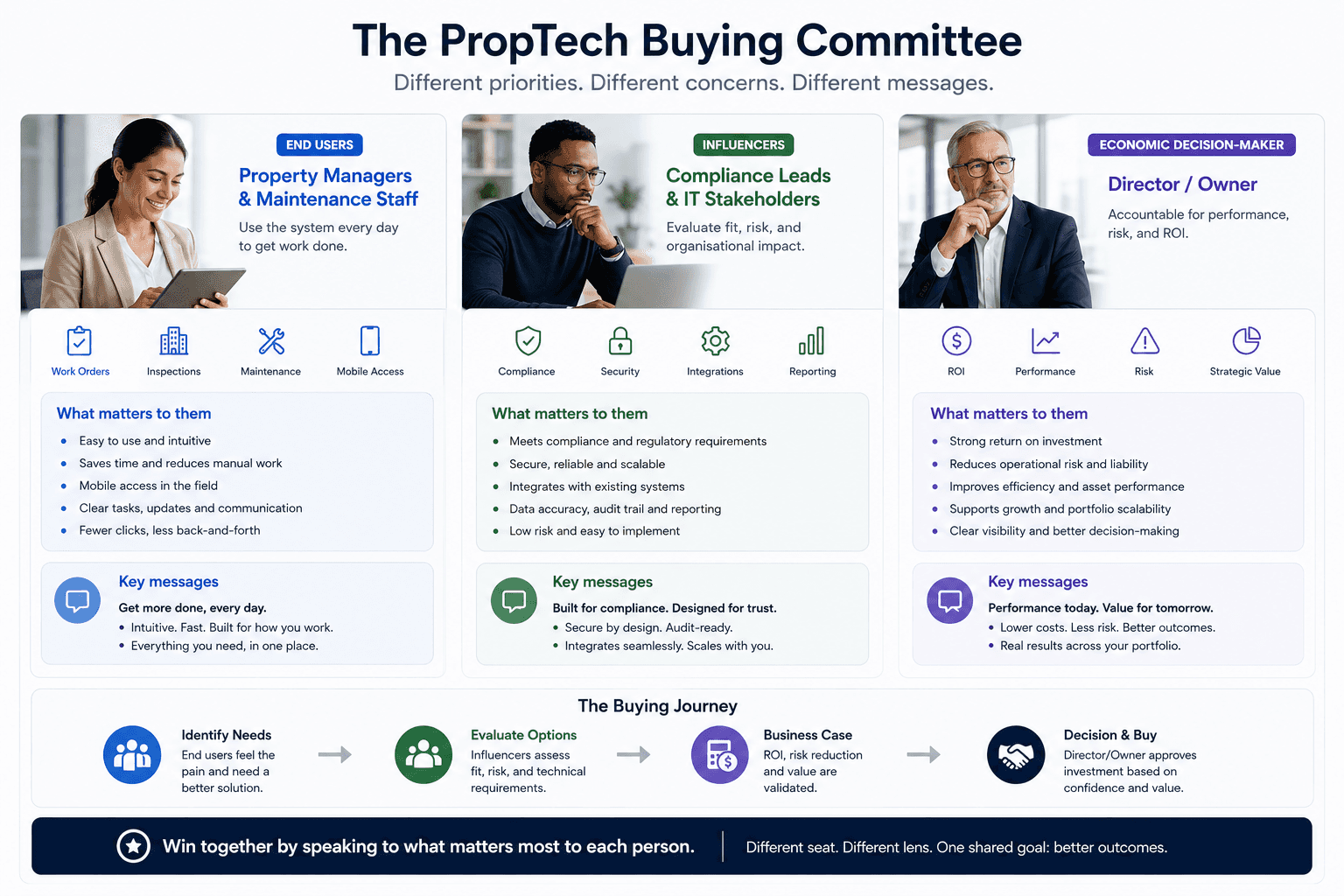
Property management organisations have a distinctive buying structure. The person who feels your product’s pain most acutely: the property manager, maintenance coordinator or compliance officer is almost never the person who signs the contract. The economic decision sits with the director, partner, or head of operations, and their concerns are different. That person isn’t interested in whether your maintenance workflow is elegantly designed. They want to know whether it reduces their liability exposure, whether their team will adopt it, and whether the migration will disrupt operations during a busy quarter. Most PropTech marketing speaks to the person who feels the pain and ignores the person who holds the budget. You need both: the product narrative wins the user; the commercial case wins the buyer. Keep them as two distinct narratives rather than conflating them into one piece that speaks clearly to neither.
Mistake 2: Category Education Instead of Problem Positioning
Early-stage founders often spend their budget educating the market about their category: “Here’s what AI-powered property management software can do.” “The future of smart building management.” This content isn’t wrong, it’s just slow. Category education takes years and budgets most founders don’t have, and it doesn’t convert. The property managers and directors closest to buying aren’t searching for category definitions. They’re searching for solutions to specific, named pains: “how to reduce maintenance response time,” “why maintenance invoices don’t match work orders,” “how to pass a fire safety audit faster.” Speak to those problems concretely, with evidence from real deployments, and you’ll find buyers already in motion. The shift is from “here’s what this technology does” to “here’s the problem you’re having, why it happens, and what fixing it looks like.” A harder brief to write but it converts.
“The mistake I see most often in B2B PropTech marketing is solution-first positioning. Nobody wakes up wanting software. They wake up wanting to stop losing maintenance margin or stop fielding landlord complaints about slow response times. Start there.”
-Louisa Dickins, Co-Founder, LMRE
Mistake 3: Ignoring the Length of the Buying Cycle
PropTech SaaS for property management firms has a buying cycle that runs from three months to over a year. The decision involves multiple stakeholders, a migration plan, and often board or partner sign-off. Yet most PropTech marketing is built for a short cycle a landing page, a free trial, a demo request. That’s fine as a conversion mechanism once someone is ready to buy. But if someone discovers you twelve months before they’re ready to act, your job is to remain visible, credible and relevant throughout their buying journey. That requires a content and nurture strategy, not just a conversion funnel. The firms that grow predictably maintain a consistent presence where their buyers spend time: industry associations, trade publications, LinkedIn communities, event circuits. Not because every touchpoint converts most don’t but because when the buying moment arrives, being the name someone already knows, and trusts is worth more than any campaign you can run in that moment.

Mistake 4: Case Studies That Don’t Prove Anything
A case study that converts a sceptical buyer answers specific questions: What was the client’s situation before? What was the exact problem not the category, the issue? What did implementation involve, and how long did it take? What were the measurable outcomes not “improved efficiency” but “reduced maintenance response time from 8 days to 2.5 days” or “increased on-time rent collection from 71% to 89%”? What would they tell a peer considering the same switch? Specificity builds credibility. Experienced buyers filter out vague success stories because they’ve seen too many; specific, evidenced outcomes with named clients and real numbers are rare, and they work. If you do only one thing to improve your PropTech marketing this year, go back to your three best client relationships and invest the time to build properly evidenced case studies with numbers, a named contact, and a quote about a specific outcome.
“The best B2B case studies read like referrals from a trusted colleague. They’re specific, credible, and honest about the implementation challenges. Anything less than that is just marketing material that educated buyers skip.”
-Andrew Stanton, PropTech Industry Commentator, Proptech-X
Mistake 5: Building the Wrong Kind of Website
PropTech websites tend to look like generic SaaS product sites hero image, feature grid, pricing page, free-trial CTA. That’s what the templates produce, so that’s what gets built. The problem is that property management directors making six-figure software decisions don’t buy the way a startup founder buys a project management tool. They need to understand the vendor as an organisation, not just the product as feature set evidence of the team, the implementation approach, references they can call, and a sense of how long the company will be around. Your website needs to answer the questions a credibility-seeking buyer will have: How long have you operated? How many clients do you manage? What does implementation look like? Who are the people behind the support line? What do customers say specifically, rather than generally? Those answers need not hide on an About page weave them throughout your main messaging. But they need to exist.
What Actually Works in PropTech Marketing?
The PropTech companies that grow consistently share a few characteristics in how they market:
Narrow targeting, at least initially. Rather than addressing all property managers, they pick a segment like HMO landlords, build-to-rent operators, commercial agents and become visibly credible there before expanding. Being the obvious choice for one segment beats being a plausible option for five.
Content that proves expertise, not just explains the product. Guides and webinars demonstrating operational knowledge build the trust that shortens sales cycles when buyers are ready.
Partnerships with trusted associations. ARMA, ARLA Propertymark, RICS, and sector trade bodies carry credibility with property professionals that transfers differently than advertising.
Referrals, taken seriously. Word of mouth drives more PropTech purchasing than most founders track. A referral programme with real incentives, and a culture of asking happy clients for introductions, outperforms most paid channels in this market.
The Bottom Line: Build Trust Before the Buying Moment
PropTech marketing is hard because the market is conservative, the buying cycle is long, and trust is built slowly. None of that improves by getting the basics wrong. The founders who build sustainable growth know their buyer deeply not just the user, but the economic decision-maker and build a body of evidence (case studies, references, content, reputation) that makes them the credible choice when the buying moment arrives. That’s less exciting than a campaign and takes longer than a launch. But it compounds in a way campaigns don’t.
Looking to build sustainable growth for your PropTech business? Get in touch to explore solutions that help you strengthen your market presence, build trust, and accelerate long-term growth.
Why is marketing a PropTech product different from marketing another SaaS?
What content works best for marketing property management software?
How long is the typical PropTech sales cycle for B2B customers?
What makes a good PropTech case study?
What are the most effective channels for PropTech marketing in the UK?
How do you market property management software?