Reading time: 5 minutes

An AI-native SaaS platform is one built from the ground up with AI as a core architectural assumption embedded in the data model, workflow logic, and decision-making rather than added as a feature on top of an existing product.
That distinction matters because two very different products ship under the same label today. One is built with AI as infrastructure. The other simply adds a ChatGPT wrapper to an existing product and markets itself as AI-powered. The marketing looks identical; the implementation reality doesn’t. I’ve worked in property technology for over a decade and watched this pattern repeat with every major shift: cloud, mobile, and now AI. A small cohort of genuinely new approaches emerge; a much larger cohort adds a tab or an integration and calls itself transformed. So, when people ask what “AI-native” means for a SaaS platform, it’s worth being specific. This guide covers the difference, what AI-native requires, the common misconceptions, and how to evaluate a vendor’s claim.
What Is the Difference Between AI-Added and AI-Native?
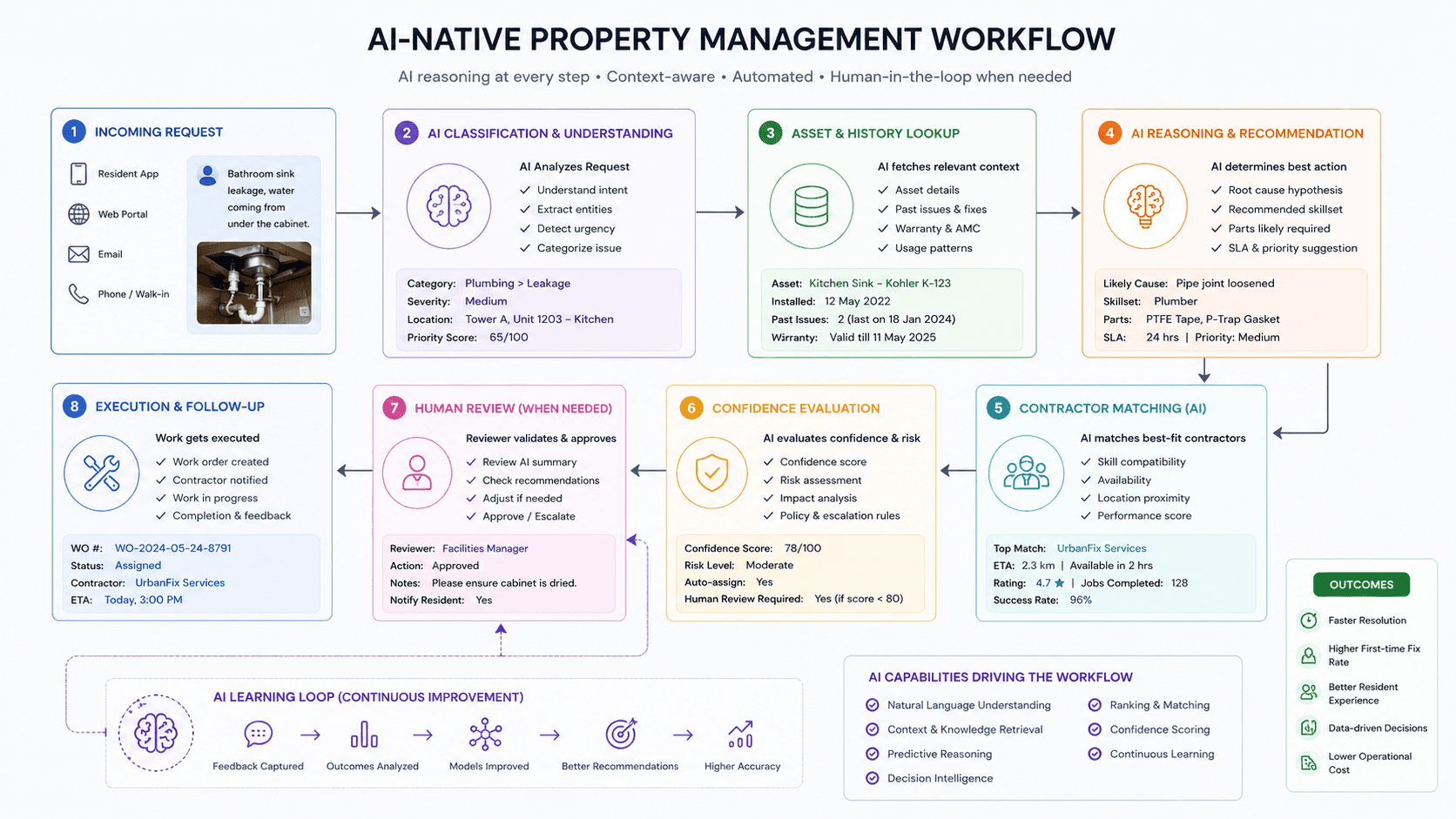
An AI-added product uses AI as a feature; you can usually spot it because the AI lives in a distinct, isolated part of the product like a Copilot sidebar, a summary button, a chat interface that doesn’t touch the core workflow. An AI-native product uses AI as infrastructure woven into the data model, workflow logic, and user experience in a way that couldn’t be removed without rebuilding the product.
Here’s the distinction applied to property management:
The AI-native version requires the model to access structured, reliable data across multiple domains complaints, assets, contractors, and historical outcomes, in a format it can reason over. That’s an architectural decision, not a feature decision.

What Does AI-Native Actually Require?
A Data Model Built for Inference
Traditional SaaS data models are built for storage and retrieval. An AI-native data model is built for inference, where relationships between entities, historical patterns, and contextual metadata are first-class considerations. A traditional system stores a lease’s terms; an AI-native system also stores interaction history, payment-behaviour patterns, communication-sentiment trends, and renewal-risk indicators in a form the model can reason about.
Feedback Loops as a Core Feature
AI systems improve with structured feedback. An AI-native platform captures not only outcomes, but also the decisions that lead to them. It records whether recommendations are accepted or overridden, and whether predicted risks ultimately materialise. This feedback helps the system improve over time. Most AI-added products capture none of this: the AI suggests, the user acts or doesn’t, and nothing about the decision is recorded. The model never learns.
“The real unlock for AI in property management isn’t the model itself, it’s the quality of operational data it has access to. Most PropTech platforms have years of structured transactional data that’s never been used for anything beyond reporting.”
-James Dearsley, Co-Founder, Unissu
Common Misconceptions About AI in Property Management SaaS
Three beliefs cause most of the confusion. Each one is worth correcting directly.
Myth 1: “AI-native means fully automated”
Reality: Good AI-native products are designed for human-in-the-loop workflows. The AI manages high-volume, low-ambiguity decisions automatically and surfaces the rest for human review. A system that automates everything regardless of confidence makes costly mistakes; a system that routes everything to humans isn’t really using AI.
Myth 2: “The AI will figure out the data quality problem”
Reality: AI trained on bad data produces confidently wrong outputs. If your maintenance records are incomplete, your contractor data is stale, and your lease records have duplicates, an AI layer won’t fix that, it will amplify it. Data quality is a prerequisite, not a downstream benefit.
Myth 3: “Any LLM integration makes a product AI-native”
Reality: LLMs are genuinely useful for drafting communications, summarising documents, and answering natural-language queries. But an LLM that drafts a tenancy notice is different from an AI system that understands the full context of a tenancy, knows the regulatory requirements, tracks outstanding obligations, and initiates the right action at the right time. The latter needs structured data and workflow intelligence, not just text generation.
“Generative AI tools are great for drafting text. But property management is fundamentally a decisions and actions business, not a text business. The platforms that will create real value are the ones that understand that distinction.”
-Eddie Holmes, CEO, Kamma
How Do You Evaluate Whether a Platform Is Genuinely AI-Native?
When a vendor says their platform is AI-native, ask these four questions:
Where does the AI sit in the workflow? Is it generating outputs, or participating in decisions that trigger actions?
What data does the AI have access to? Is it reasoning over your specific historical data, or operating on generic inputs?
What happens when the AI is wrong? Is there a correction mechanism that feeds back into the model?
Can you explain a decision the AI made? Can the platform show why a recommendation was made, and from which data points?
A vendor who answers these concretely with a product demonstration rather than slide decks is probably building something real.
What Does This Mean for Buyers?
If you’re evaluating property management software, AI capability should now be a consideration. The question is no longer whether a platform has AI; most vendors do. The real question is where AI sits within the product, what data it can access, and how it influences operational decisions.
The practical test is simple: ask the vendor to show you, in the product, how the AI participates in a real workflow decision. Not how it generates text how it changes what happens next.
If you’d like to explore this further or discuss a customised unified solution for your operations, Get in touch we’d be happy to help.
You can also read: The Real Cost of Running Four Property Systems at Once.
What does AI-native mean in SaaS?
How is AI-native different from AI-powered or AI-enhanced software?
What should AI in property management software do?
Is ChatGPT or a large language model the same as AI-native?
How can I tell if a PropTech vendor is genuinely AI-native?
Can an AI-native platform work without structured data?